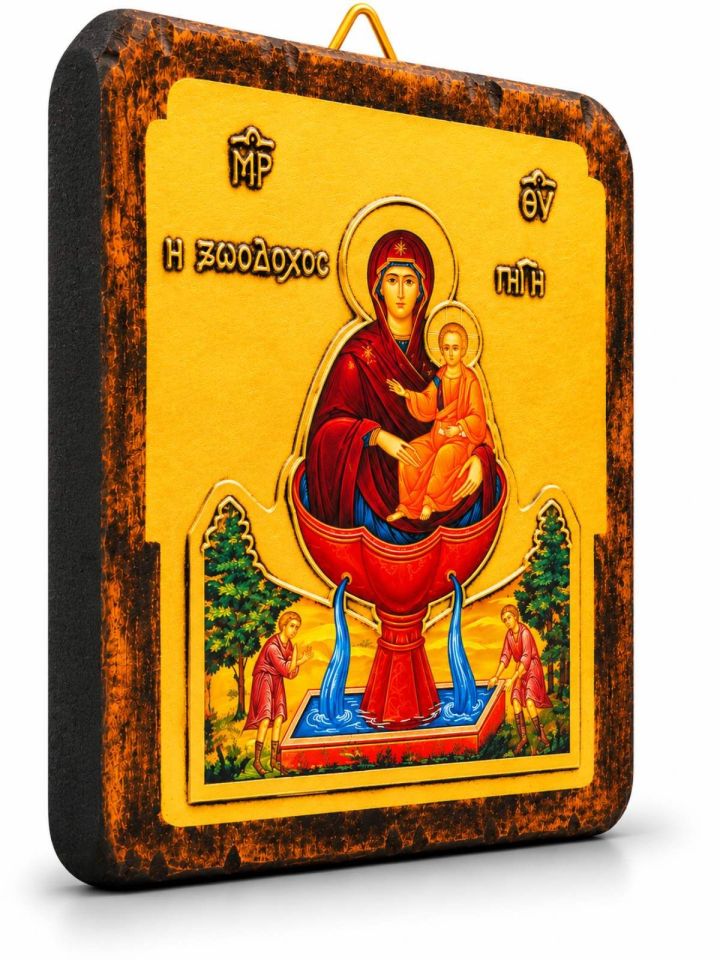
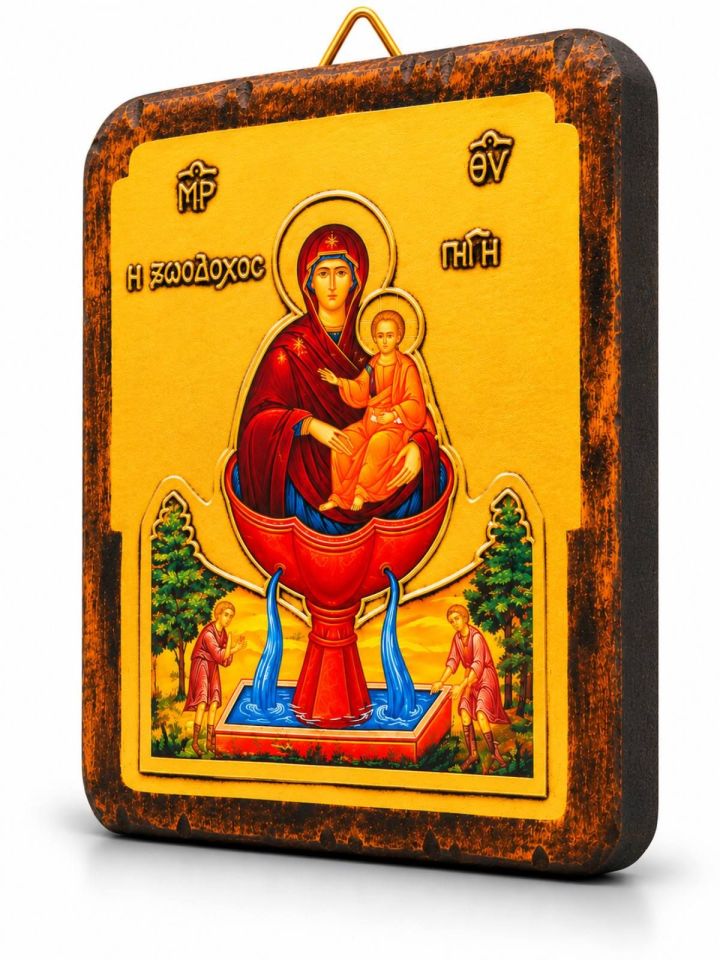
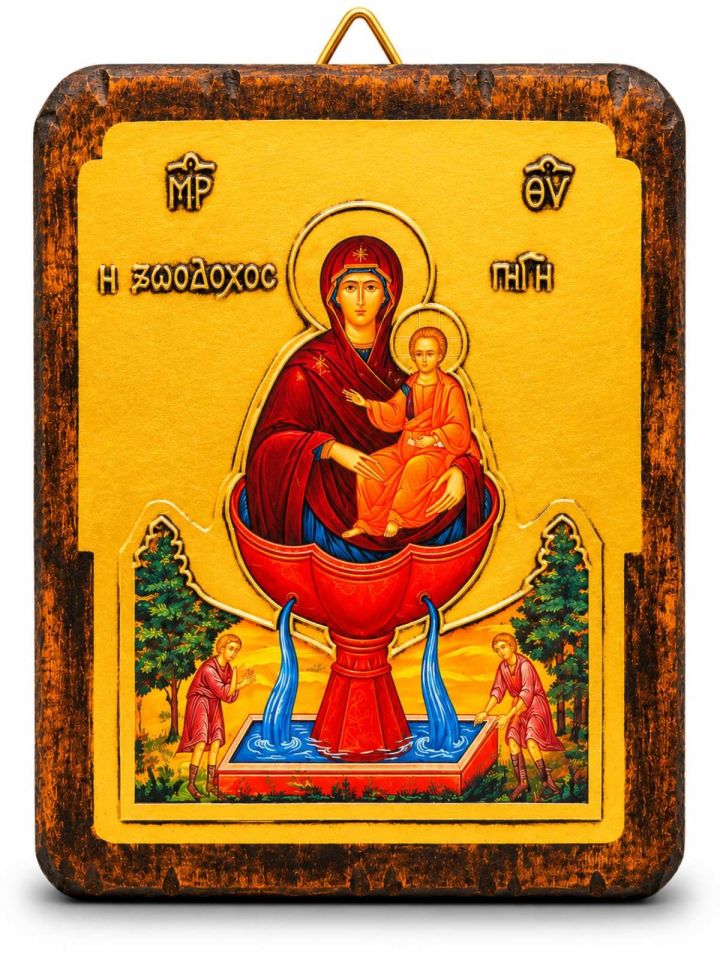
The Mother of God, the Life-Giving Spring
Around AD 450, a Byzantine soldier named Leo was in a forest when he came across a blind man who asked him for a little water to quench his thirst. Leo offered to find some for him. He searched the forest for a long time, hoping to find a spring, but his efforts were in vain. Disheartened, he returned to the man.
Suddenly, Leo heard a woman’s voice say, “There is no need to worry, Leo. The water is close by.” A little later, he heard the voice again. “Leo, O Emperor, take some of this water and give it to the blind man to quench his thirst. Then anoint his eyes with it, and you will know at once who is speaking to you.”
Leo did as he was told, and the blind man immediately regained his sight. At that very moment, Leo’s own eyes were opened. He realised that it was the Virgin Mary who had spoken to him and that the miraculous healing had come through her.
The discovery of the spring and its healing waters was itself a wonder. So too was the fulfilment of the Virgin Mary’s words when she addressed Leo as emperor. The account places his accession in AD 486 and identifies him as Leo I the Thracian, also known as Macelles, whose reign is given as 457–474.
As emperor, Leo built a magnificent church at the site of the miraculous spring and dedicated it to the Mother of God, the Life-Giving Spring. He built it in remembrance of the blessings the Theotokos had bestowed on him and of her many acts of kindness towards all humanity.
The miraculous spring healed many of the faithful, including Emperor Justinian I, Leo VI the Wise and his wife, Saint Theophano, Romanos I Lekapenos and his wife, Patriarch Stephen (886–912), and Patriarch John of Jerusalem (964–966). Many other rulers and ordinary people were also healed. The holy water of the Life-Giving Spring is even said to have brought a dead man back to life.
The Turks later demolished the Church of the Life-Giving Spring and used its materials to build the mosque of Sultan Bayezid. Christians built a chapel on the site and later erected a larger church in 1835.
The Orthodox Church commemorates the dedication of the Church of the Most Holy Theotokos, the Life-Giving Spring, on Bright Friday, the Friday after Easter. The site became known as the holy spring of Balıklı. The Turkish word balık means “fish.” According to tradition, on 23 May 1453, a monk was frying fish beside the spring when he heard that the Turks had taken Constantinople. He said he would believe the news only if the fish leapt out of the frying pan and fell into the holy spring. The fish came to life and jumped into the water. To this day, seven fish are kept in the basin of the Life-Giving Spring.
Beyond these legends and traditions, the Virgin Mary, Mother of Christ and mother of all Christians, remains for us the Spring of Life. She brought Christ, who is Life itself, into the world and remains our hope and protection, our “refuge, shelter, and joy.”
The Greek text gives AD 486 as the year of Leo’s accession, although it lists his reign as 457–474. Both dates are retained here.


Comments (0)
Your review appreciation cannot be sent
Report comment
Report sent
Your report cannot be sent