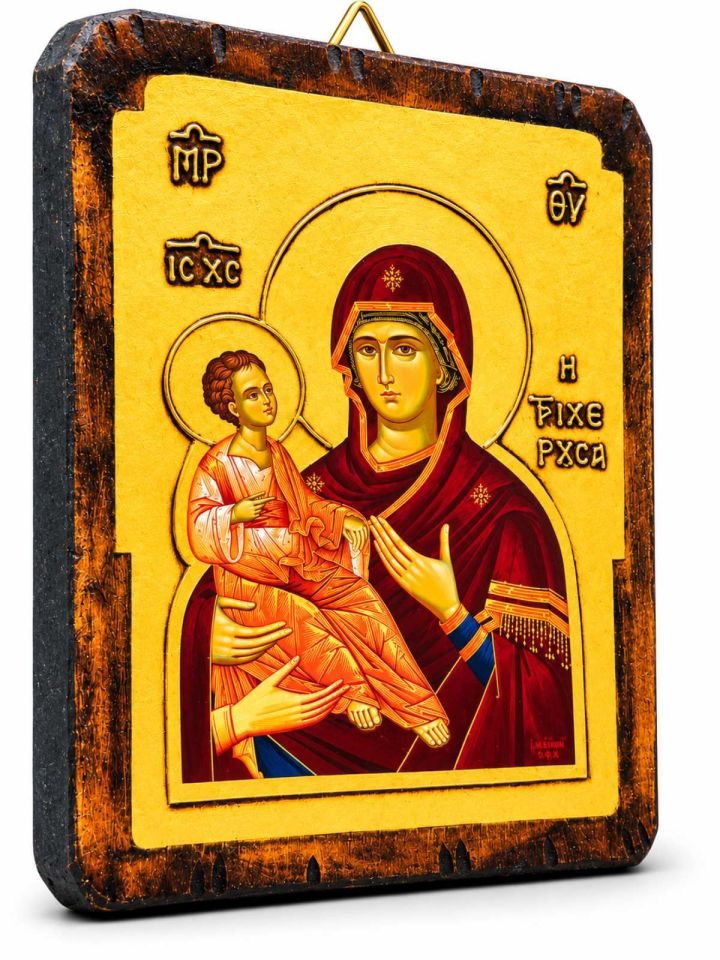
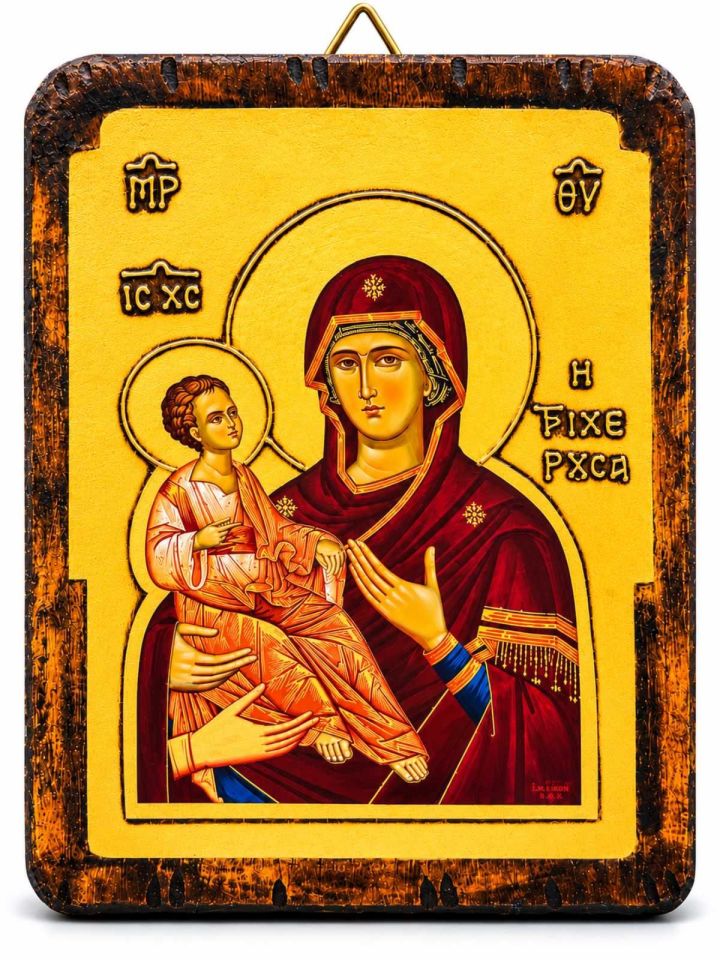
Virgin Mary Tricherousa images
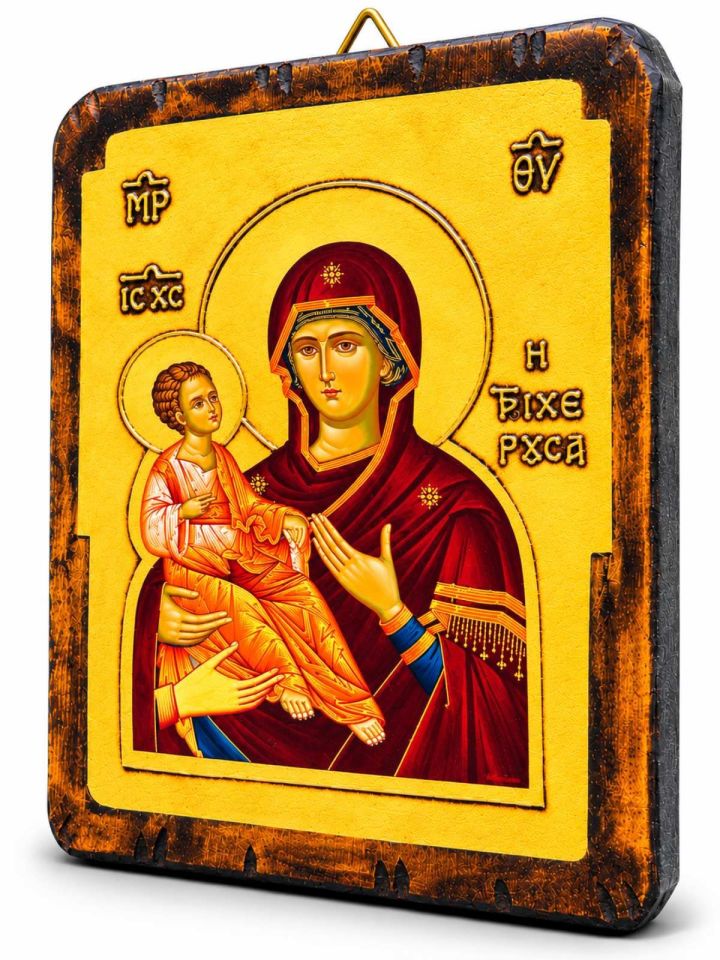
Virgin Mary Tricherousa
Price:
€15.00
Tax included
The miraculous icon of Panagia Tricherousa was a family heirloom of Saint John of Damascus, who kept it with reverence in the chapel of his house. St. John Damascene was the first advisor to Walid, the Caliph of Syria, in the years 705-715, on all necessary matters concerning the Christian population of that region.
Lithography in natural wood.
The History of the Holy Icon of the Virgin Mary Tricherousa (The Three-Handed Mother of God)
During the reign of Emperor Leo III the Isaurian in Constantinople, the period of Iconoclasm began. The veneration of holy icons was considered a form of idolatry. Saint John of Damascus became a passionate defender of holy icons and, through his writings, strongly opposed the heresy of Iconoclasm.
In an attempt to eliminate the influence of Saint John of Damascus, Emperor Leo III falsely accused him before Caliph Walid, claiming that the Saint was secretly planning to help the Emperor capture Damascus.
The Caliph immediately ordered the arrest of Saint John of Damascus and commanded that his right hand be cut off in the public square of Damascus. The order was carried out without delay.
Saint John retrieved his severed hand and spent the entire night kneeling before an icon of the Virgin Mary, earnestly praying for healing so that he could continue his struggle in defense of the Orthodox faith.
Exhausted from his prayers, he eventually fell asleep for a short while. During his sleep, he experienced a vision in which the Virgin Mary spoke to him through her holy icon, assuring him that his hand would be healed.
When the Saint awoke, he discovered that his hand had indeed been miraculously restored and was completely healthy.
Overwhelmed with joy and gratitude, he commissioned a silver replica of his healed hand and placed it beneath the left side of the icon of the Virgin Mary.
It was because of this miraculous event that the icon became known as Panagia Tricherousa (The Three-Handed Mother of God).
Following this extraordinary miracle, Saint John of Damascus decided to abandon his worldly positions and become a monk at the Monastery of Saint Sabbas the Sanctified in Palestine. He took the holy icon of the Virgin Mary Tricherousa with him.
The Journey of the Holy Icon to Mount Athos
In 1217, Saint Sava of Hilandar, son of the Serbian ruler Stefan Nemanja, who later became known as Simeon, visited the Monastery of Saint Sabbas the Sanctified.
During his visit, he received the icon of the Virgin Mary Galaktotrophousa (The Milk-Giving Mother of God), the pastoral staff of the monastery's founder, and the icon of the Virgin Mary Tricherousa.
He brought these sacred treasures to the Holy Monastery of Hilandar on Mount Athos, where the icon of the Virgin Mary Tricherousa remained until 1347.
That year, the Serbian ruler Dušan visited Mount Athos. Upon returning to his homeland, he took the icon of the Virgin Mary Tricherousa with him as a blessing.
The holy icon was then housed at the Monastery of Studenica in Serbia.
The Miraculous Return of the Icon to Hilandar
At the beginning of the 15th century, when the Serbian people learned that their homeland was threatened by Ottoman conquest, they decided to protect the sacred icon.
They removed the icon of the Virgin Mary Tricherousa from the Serbian monastery, placed it on the back of a donkey, and allowed the animal to wander freely, trusting that the Virgin Mary herself would guide it to its destination.
According to sacred tradition, the gentle animal miraculously traveled across Serbia and the Greek region of Macedonia before finally reaching Mount Athos and the Holy Monastery of Hilandar.
The monks welcomed the icon with great honor, prayers, and religious processions.
Tradition further recounts that as soon as the holy icon was placed inside the sanctuary of the monastery, the blessed donkey fell to the ground and died.
The Virgin Mary Tricherousa – Abbess and Protectress of Hilandar
To this day, the holy icon of the Virgin Mary Tricherousa is regarded as the Abbess and Protectress of the Holy Monastery of Hilandar, as well as the spiritual Protectress of the Serbian Orthodox people.
The icon itself is considered one of the best-preserved ancient Byzantine icons of the Mother of God.
The face of the Virgin Mary is depicted with remarkable beauty and expression, while her gentle and compassionate gaze inspires profound reverence and emotion among those who venerate her.
For protection and as a sign of honor, the sacred icon is adorned with a magnificent golden covering (riza), decorated with approximately 5,000 precious gemstones.
Source: Informational leaflet “To the Parishioners” of the Orthodox Parish of Hagen & Lüdenscheid.
-
Referencei-462
 Safe shopping
Card via Nexi or bank transfer
 Worldwide delivery
By courier in Greece and abroad
 Return policy
How to return a product
 Customer support
Phone, WhatsApp and Viber
4 other products in the same category
Comments (0)
Your review appreciation cannot be sent
Report comment
Report sent
Your report cannot be sent